The concept of platonic love can be defined as following.
Platonic Love is a strong type of love that is essentially non-sexual.The earliest mention of platonic love comes from the Plato's dialog called Symposium. It has been a general discussion that has happened in 416 BCE. It was hosted by the poet Agathon to celebrate his first victory of a dramatic competition. The discussion has since become famous and plato has documented it in a narrative format of the respective philosophers who were present. Following is a fresco that was found showing the Symposium.
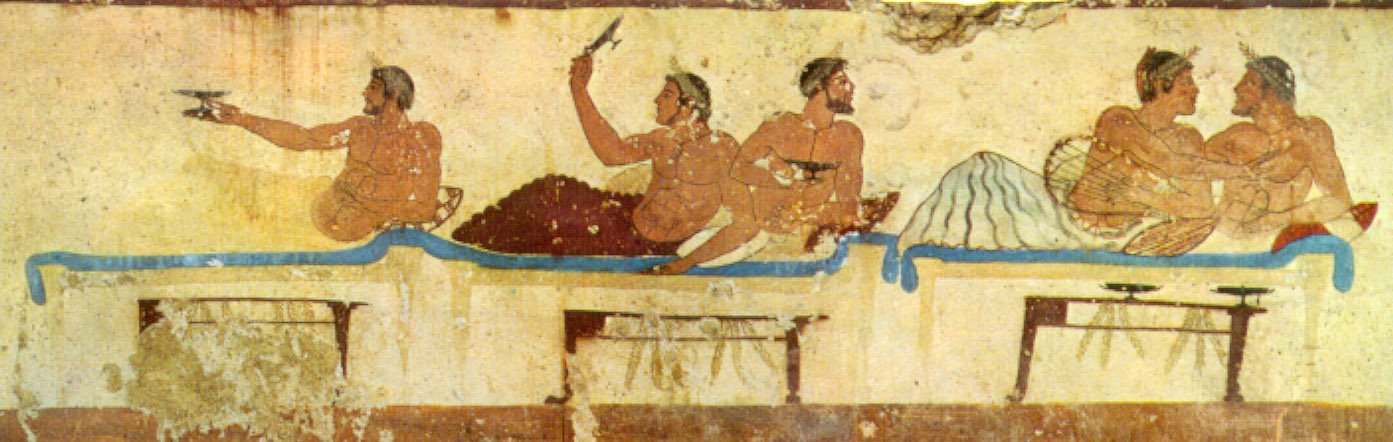
The origin of platonic love comes from the speech given by Socrates. The conversation in brief is as follows.
"Then, may I ask Agathon a few questions?"This is actually a conversation that is abstract yet carries a brilliant intellectuality. Love is of something that it lacks, thus when love loves beauty, that means love lacks beauty. But the fact that love lacks beauty does not mean that love is ugly! The argument Socrates states is as follows. He also states that he has burrowed the argument from prophetess Diotima of Mantinea who seems to be the mother of the concept.
"Certainly."
"Is Love love of something, or of nothing? A father is father of his child. A brother is brother of his brother and sister. Is Love in like manner love of something?"
"Certainly."
"It desires that of which it is the love, not possessing it?"
"Yes.""When it no longer lacks, it no longer desires?"
"I suppose not."
"Well, then, Love is of something that it lacks. But you would have it that Love loves beauty; therefore it lacks beauty; therefore it is not beautiful. And the same argument applies to goodness as to beauty! However, let me tell you what the prophetess Diotima told me, for I have borrowed my argument from her, since I was arguing with her very much as Agathon has been doing just now.
What is not beautiful or good, need not, therefore, be ugly or bad, just as there is a state of mind which is neither knowledge nor ignorance, but correct opinion. So Love is not a mortal, nor a god, since we have seen that he does not possess all beauty and goodness and happiness, which we must acknowledge the gods to possess, but is something intermediate, a daemon, interpreting between the divine and the human. Love is one of many such intermediaries. As to his birth, Plenty was his sire and Poverty his mother; he partakes of the nature of each. As the gods do not seek wisdom, since they imagine that they have it, but only the philosophers, who are neither of these; so Love is of necessity a philosopher, thirsting for wisdom as for all forms of beauty. Your mistake was in taking Love to be not the lover, but the beloved.This gives rise to a concept that can be applied to almost anything. The existence of a genetic intermediary, a middle layer between any two abstractions is explained rather clearly by Plato's examples. The concept itself is rather subtle, what is not beautiful doesn't need to be either ugly or bad, how true can that be in even the present context ? We as human beings always try to discriminate something to be either good or bad, but what happens to what's in between? The fact that we are in a digital world doesn't mean our choices are limited to been digital as well. This argument would lay a real light upon people who think our decisions should be of digital nature and there can be nothing in between.
Turning back to the concept of platonic love, Socrates further states the following.
LOVE, you say, desires the possession of beautiful things. What will he possess? The happy are happy in the possession of good things. Everyone desires to possess good things. But we do not admit that everyone loves, because we have selected a specific form of love, and chosen to apply to the species the name of a universal; just as every maker is properly a poet, but we have appropriated the name to a particular species of makers. Love, in reality is of every good, not of the missing half of oneself; desire that it should be ever present with it. It acts as the desire of generation in the beautiful, in relation both to body and soul, a something immortal in mortality as it were; not of the beautiful; but of immortality, necessarily, without which nothing can be ever present.As he correctly puts it, we are limiting ourself to a specific form of something, and neglect the fact that it can be polymorphic, that it can evolve and change, that it can have different forms in different contexts. He then makes his point on platonic love.
As for the phenomena of Love permeating all the living creation, they express the mortal nature seeking to become deathless by the one possible process of generation. For the mortal achieves immortality by the constant replacing of that which perishes, not by its separate continuity. So this Love is a tendency towards eternity and great deeds done for the immortality they bring. Sexual love is the expression of this craving for immortality in the physical organism; the work of all creative art is its intellectual issue, and especially of that political wisdom which we call moderation and justice. In whatsoever field this desire of immortality by propagation moves us, we must be attracted by the beautiful, and by beauty of soul more divinely than by beauty of form. But the children of the intellect are more desirable than the children of the body; for the former may bring the reward even of divine honours, but not the latter.He righteously points out that sexual love as the expression of the craving of physical immortality of the physical organism by continuation of a successor, not by the continuation of itself. And so he gives rise to the idea of a love that would make us immortal beyond physical means, a love is attracted to the beautiful, but to the beauty of the soul more divinely than the beauty of the physical form. Thus he emphasize that unlike children of body, the children of intellectuality achieves immortality and results in divine honors.
He who would love rightly must from the beginning seek to hold intercourse with beautiful forms, and love one, wherein he would generate intellectual beauty. But the beauty in all forms is one, and his love of beauty in form would be divided among many forms; whereas beauty in the soul being more excellent, one beautiful soul would suffice him even though the beauty of the form withered. Thus he would be led up to the contemplation of universal beauty, and the one science thereof. The beauty thus revealed is eternal, without beginning at all times, and utterly, and to all. This is that to which they attain who advance by these steps from the contemplation of beauty in particulars to the revelation of the supreme beauty. Such a one is at last in contact not with shadows but with the ultimate reality, and if immortality be at all given to human beings, he is thereby become immortal.The final piece of the conversation clears any doubts that the other philosophers had at the symposium. It is intended to emphasize the fact, in short, one loves to be immortal and thus it is appreciated to gain eternal immortality by bearing an intellectual child rather than the mere continuation of children of body. But at the same time, the platonic love for one's soul emerges from the argument. One beautiful soul would suffice oneself even the beauty of the form withers. Thus is it intended to lead one to contemplation of universal beauty.
This been a brief description about the origin of platonic love, let us move in to the context of existence of platonic love in present context.
It is often understood as relationship that is deep, non-sexual friendship between two heterosexual people of the opposite sexes. But this in turn challenges the ideology of platonic love, which from its origin was that of a chaste but passionate love, based not on uninterest but virtuous restraint of sexual desire. So it seems that the ideology of Platonic love doesn't exist in it's original form, but rather some variants of it exists.


0 comments:
Post a Comment